Is the Massive Price Jump Actually Worth It?
If you are stuck choosing between a £50 Padel Racket VS £250 Padel Racket, the honest truth is that the “best” choice depends entirely on your swing speed and how often you play. While a £50 entry-level racket offers durability and a forgiving “sweet spot” for beginners, a £250 premium model provides the carbon fiber rigidity and advanced power needed for competitive play. You don’t always need to spend hundreds to enjoy the game, but understanding the technical differences in materials and vibration dampening will prevent you from wasting money on a racket that either hinders your growth or breaks under high-intensity use.
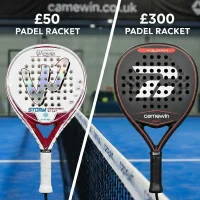
The Material War: Fiberglass vs. Carbon Fiber
The most immediate difference when comparing a £50 Padel Racket VS £250 Padel Racket is the material used in the frame and face. Most rackets in the £50 range utilize fiberglass. This material is naturally softer and more flexible. For a beginner, this is a secret weapon; it creates a “trampoline effect” where the ball bounces off the surface with very little physical effort from the player. It makes the game feel easier when you are still mastering your footwork.
However, once you move to a £250 racket, you enter the world of high-grade carbon fiber (often labeled as 3K, 12K, or 18K). Carbon fiber is significantly stiffer and lighter. This stiffness is why professionals love it—it does not “eat” the energy of your swing. When you hit a smash with a premium carbon racket, the energy transfer is direct and explosive. If you try to hit that same shot with a £50 fiberglass model, the material flexes, absorbing the power and leaving your shot feeling “mushy.”
Core Density: The "Engine" of Your Racket
- Inside every Padel racket is a core, usually made of EVA foam or Polyethylene (FOAM). This is where the price gap becomes physically noticeable during a long match.
- The £50 Choice:Usually features Soft EVA or FOAM cores. These are designed for maximum comfort and . They are incredibly “kind” to your joints, making them the best choice for players prone to tennis elbow.
- The £250 Choice:Often utilizes High-Density EVA or multi-layered cores. These are much harder. While they provide incredible feedback and “pop,” they are less forgiving. If you don’t hit the ball exactly in the center, a £250 racket will send a stinging vibration up your arm. This is why expensive rackets are actually harder to play with for novices.
Sweet Spot and Forgiveness
A £50 Racket VS £250 Racket comparison also reveals a major difference in the “sweet spot”—the area of the racket that produces the best hit. Cheap rackets are almost always . Round rackets have a massive sweet spot right in the center. Even if you are late to the ball or hit it slightly off-center, the racket helps you out.
Premium £250 rackets are frequently. These are “head-heavy,” meaning the weight is balanced toward the top to give you more leverage on overheads. The trade-off? The sweet spot is much smaller and sits higher up. If you haven’t perfected your timing, you will find yourself hitting “dead” shots that barely reach the net, making the £250 investment feel like a total waste of money.
The Role of Technology and Customization
- When you pay £250, you are not just paying for the name; you are paying for engineering. High-end models from brands like Bullpadel or Adidas often include:
- Rough Surfaces:Sandpaper-like textures or 3D patterns on the face to help you “grip” the ball for .
- Weight Systems:Some premium rackets allow you to add or remove small weights to change the balance of the racket mid-season.
- Anti-Vibration Bridges:Specialized silicon inserts in the handle to kill vibrations before they reach your wrist.
- A £50 racket is a “static” tool. It is what it is. You cannot adjust it, and the surface is usually smooth, making it much harder to generate the “kick” needed for advanced slices.
Durability Myths: Is Expensive More Rugged?
Surprisingly, in the battle of £50 Padel Racket VS £250 Padel Racket, the cheaper one might actually last longer in the hands of a clumsy player. Fiberglass is more resilient to impact than brittle carbon fiber. If you accidentally clatter your racket against the glass wall or your partner’s frame, a £50 fiberglass racket is more likely to walk away with a scratch, while a £250 carbon racket might suffer a structural crack. However, the performance of a cheap racket degrades faster. After six months of heavy play, the soft foam inside a budget racket often “dies,” losing its bounce, whereas premium EVA stays reactive for much longer.
The Verdict: Who Wins?
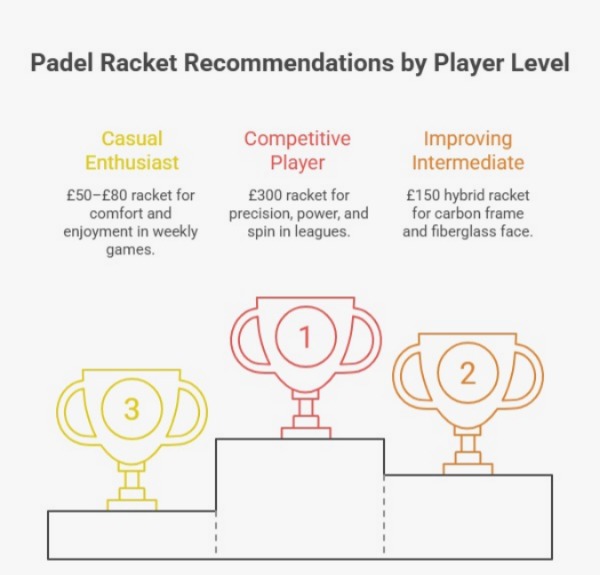
The winner of the this debate depends on your “Padel identity.”
- The Casual Enthusiast:If you play once a week for fun, stick to the £50–£80 range. You won’t benefit from the carbon stiffness, and the extra comfort will keep you playing longer.
- The Improving Intermediate:You should look for a “hybrid” around the £150 mark—carbon frame with a fiberglass face.
- The Competitive Player:If you are playing 3+ times a week and competing in leagues, the £250 racket is a necessary tool. The precision, power, and spin potential are vital once your opponents stop giving you easy balls.
Ultimately, a racket won’t fix bad technique, but the wrong racket for your level will certainly hold you back. Start small, master the , and only upgrade to that £250 beast when you feel your current racket can no longer keep up with your power.