If you have been shopping for a padel racket recently, you will have noticed that rough surface frames are everywhere in 2026 and the marketing around them is loud. Brands claim more spin, better control, sharper shot shaping. But is any of it real, or is rough surface texture just the latest equipment trend dressed up in performance language? The answer is more nuanced than either side of the debate tends to admit and it depends significantly on who is playing the racket and how.
This guide gives you the honest, physics-grounded answer: what rough surface texture actually does to ball behaviour, where the difference is genuinely felt, where it is overstated, and which type of player gets the most real-world benefit from each. No brand bias, no marketing language just the mechanics of how padel racket surfaces interact with the ball.
What Rough Surface Texture Actually Does — The Physics
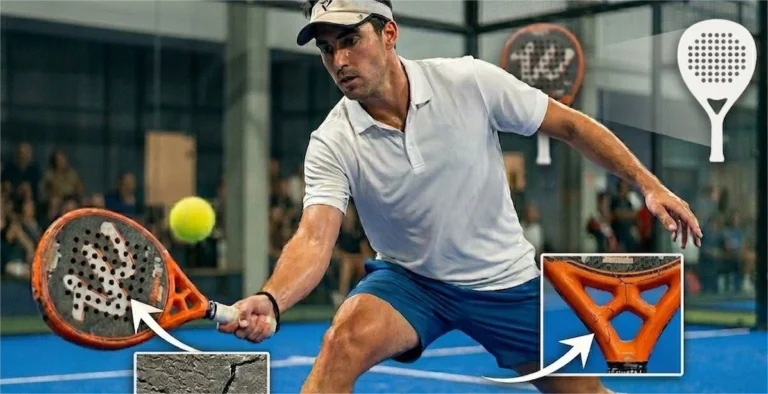
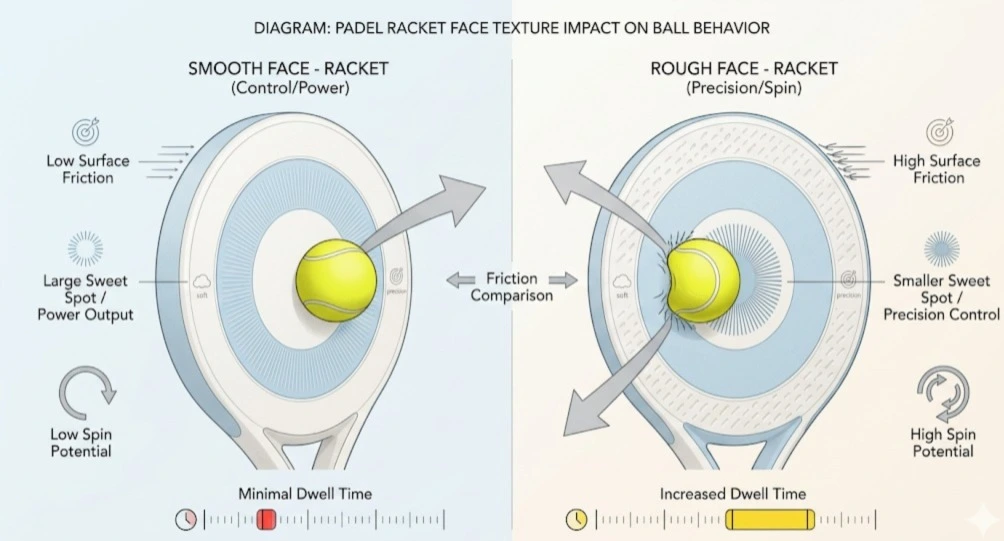
The fundamental principle behind rough surface rackets is friction. When a padel ball contacts a smooth face, the surface offers minimal grip the ball slides across the strings with relatively little traction. When it contacts a rough, textured face, the abrasive surface creates more friction at the point of contact, which translates into greater grip on the ball for the fraction of a second it is in contact with the racket.
That extra grip does two things. First, it gives you more natural spin generation on every shot without changing your swing technique, the rough face bites into the ball and rotates it more than a smooth face would on an identical swing. Second, it marginally increases dwell time the duration of ball-to-racket contact which gives your hand fractionally more time to influence the direction of the shot before the ball leaves the strings.
What the Research Actually Shows
Independent racket testing conducted by the Spanish Padel Technical Commission in 2024 published in their 2025 equipment review found that rough surface frames produced a measurable increase in ball rotation of between 8 and 14 percent compared to smooth frames under controlled swing conditions. At club level swing speeds, this translated to a noticeable change in ball trajectory and bounce behaviour, particularly on slice shots and angled volleys where spin direction is most tactically significant.
Critically, the same research found that the spin advantage was most pronounced for players who already used brushing or slicing contact in their technique. For players who hit flat with minimal wrist rotation, the difference in spin output between rough and smooth was substantially smaller because rough surface texture amplifies existing spin mechanics, it does not create them from nothing.
🔬 Key Finding: Rough surface amplifies spin you already generate. If your swing mechanics include brushing, slicing, or wrist rotation, a rough face will meaningfully increase your output. If you hit flat through the ball consistently, the spin benefit is real but smaller.
Where Rough Surface Genuinely Wins
While smooth rackets have their place, the textured face offers specific mechanical benefits that can transform your game; here is where a rough surface genuinely wins.
Spin Generation Without Extra Effort
This is the most consistent real-world benefit of rough surface rackets and the reason they have become the dominant choice among advanced club players and professionals in 2025 and 2026. A rough face generates more spin on the same shot with the same swing speed which means you get more ball movement, sharper angles, and more unpredictable bounces without increasing physical effort. Over a long match, this compounding effect on opponent discomfort is significant.
Players who already use spin-heavy technique topspin groundstrokes, vibora overheads, slice returns will feel the rough surface benefit most immediately. If your game includes any of these shots and you are currently on a smooth frame, the transition to a rough surface padel racket is one of the most technically justified upgrades available at any level.
Shot Shaping on Volleys and Redirects
At the net, the rough surface advantage is particularly pronounced on redirected volleys and angled put-aways. The additional grip at contact allows you to brush across the ball on a volley without a full slicing motion which means more disguise, less telegraphing of direction, and sharper angles with a more compact swing. This is why the rough surface trend started at professional level with net-dominant players before filtering down to club play.
Natural Slice and Chiquita Feel
The chiquita — one of the most tactically valuable underrated padel shots — benefits from rough surface texture more than almost any other shot in the game. The topspin-loaded dip of a well-executed chiquita relies on brush contact, and rough face rackets amplify that brush into a more pronounced spin than smooth frames produce. If developing your net game is a priority, this is a compelling functional reason to choose a textured frame. Advanced players ready to develop this shot will find the most relevant rough-surface options among advanced padel rackets with textured carbon faces and multi-layer cores.
🎯 Tactical Insight: Rough surface texture changes the bounce behaviour of your shots most dramatically on the third and fourth bounces particularly on glass wall ricochets. Opponents who have calibrated their positioning to your smooth frame ball trajectory will need to recalibrate. That recalibration period generates errors.
Where Smooth Surface Still Has the Advantage
For those who rely on flat power and defensive stability, a smooth finish offers a distinct edge; here is why many professionals still choose it.
Pure, Predictable Touch at the Net
Smooth surface rackets produce a cleaner, more predictable feel on soft touch shots drops, dinks, and the most delicate net exchanges where the ball barely crosses the net. The absence of surface friction means the ball leaves the face exactly as your hand guides it, without the slight unpredictability that rough surface grip can introduce on very slow, lightly contacted shots. For players whose net game relies primarily on placement precision rather than spin, smooth frames remain the more reliable tool.
Better Choice for Beginners Building Fundamentals
For players who are new to padel and still developing consistent contact mechanics, a smooth surface frame is the more forgiving starting point. The reason is counterintuitive: rough surface texture can amplify technique imperfections as readily as it amplifies good technique. A mistimed brushing contact on a rough face generates unwanted spin that sends the ball in an unintended direction. On a smooth face, the same mistimed contact produces a flatter, more manageable result. Beginner padel rackets are almost universally smooth-surfaced for exactly this reason the technology is appropriate to the skill level.
Flat Power Hitters
Players who generate pace through flat contact and full body rotation rather than spin and brush will find a smooth surface frame more consistent with their natural technique. The rough surface’s grip on flat-contact shots can occasionally create a slight drag effect at high swing speeds, producing marginally less pace than the equivalent smooth-face contact. For power-first baseliners, this is a real consideration.
💡 Honest Assessment: If you hit flat 80% of the time and are not actively working on spin mechanics, a rough surface racket will not dramatically change your game. It may improve your slice return and your vibora but it will not transform a flat game into a spin game overnight.
The Verdict: Real Difference, Right Player
Rough surface texture is a genuine technical innovation not marketing noise. The physics of friction, spin amplification, and dwell time are real and measurable. But the size of the benefit is not uniform across all players and all shots. It is largest for technically developed players who already use spin mechanics, and smallest for beginners hitting flat through the ball.
The practical implication: if you are an intermediate or advanced player with spin in your game, the move to a rough surface frame is a technically justified upgrade and the most meaningful equipment change you can make in 2026 without changing your core racket type. If you are earlier in your development, a smooth-surface beginner padel racket will serve your game better and switching to a rough surface frame is a natural step to take when your technique has developed enough to benefit from what the texture actually offers.
The best approach in either case is the same: understand what the technology does, match it to where your technique actually is not where you want it to be and let your game determine your equipment rather than the other way around.
The right surface for your racket is the one that works with your technique not the one on the racket your favourite player uses.