If you are experiencing any of the following, your equipment might be holding your game back. Here is how to identify the issue and the necessary action:
Strings Feel Dead or Lack “Pop” (High Urgency): This usually points to old strings or a significant drop in tension. Restring your racket first; if the dead feel persists, the internal core has likely failed.
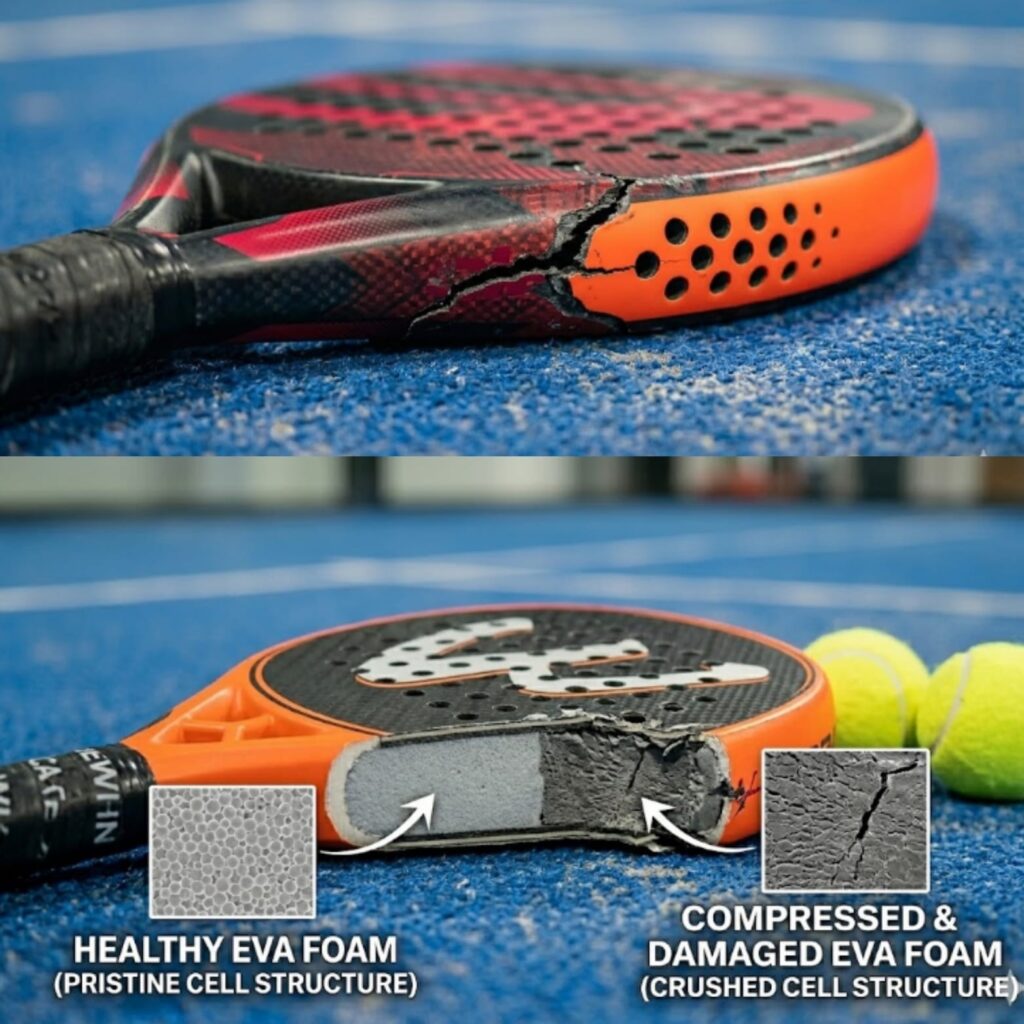
Visible Frame Cracks or Chips (Immediate Urgency): Impact damage or age-related fatigue has compromised the structural integrity. Replace the racket immediately to avoid injury or a complete break during play.
Skill Level Jump Beginner to Club (Medium Urgency): You are outgrowing your entry-level equipment and need more stability. Action: Transition to a high-quality advanced padel racket that offers a teardrop or hybrid shape to match your increasing power and control.
Consistent Elbow or Wrist Pain (High Urgency): Your current racket likely has the wrong core density or balance for your physical playstyle. Switch to a softer EVA core or a lower-balance frame to reduce vibration and protect your joints.
Lost “Sweet Spot” Feel on Center Hits (Medium–High Urgency): The foam core has suffered internal compression and no longer rebounds correctly. Upgrade your racket, as the foam has permanently degraded and can no longer provide a consistent strike.
Playing 3+ Times per Week Competitively (Medium Urgency): High frequency leads to a faster wear rate for carbon fiber and foam. If you play at this intensity, consider moving to a pro padel racket designed with higher-grade 12K or 18K carbon fiber for better long-term durability.
New 2025–2026 Technology Gaps (Low–Medium Urgency): Significant material advances, such as multi-layer cores or advanced rough-surface tech, now offer genuine performance gains. Action: Evaluate these newer models to see if updated features like improved aerodynamics or spin-textured faces fit your specific game
How Long Does a Padel Racket Actually Last?
This is the question most players ask first and the honest answer is , it depends on how often you play and how well you look after the frame. There is no universal expiry date stamped on a padel racket, but there are meaningful benchmarks based on frequency of use and playing intensity.
Racket Lifespan by Playing Frequency (2026 Benchmarks)
- Casual players (1x per week): A quality racket typically performs well for 2.5 to 3.5 years before the core shows meaningful degradation.
- Club players (2–3x per week): Expect a functional lifespan of 12 to 24 months before the sweet spot feel noticeably changes.
- Competitive or intensive players (4x+ per week): Core compression and frame stress can reduce performance within 8 to 14 months, especially in humid climates.
- Professional level: Top players on the WPT and Premier Padel circuits in 2025–2026 often rotate frames every 4 to 8 weeks though sponsorship contracts, not necessity, drive much of this.
The key variable is not time it is impact volume. A racket used in 200 high-intensity matches degrades very differently from one used in 200 casual rallies. The internal foam core is what fails first, and it does so invisibly.
Rule of Thumb: Count your sessions, not the calendar months. If you have played 150 to 200 intense sessions with the same racket, it is worth testing whether the core has compressed even if the frame looks perfect from the outside.
Sign 1: Visible Physical Damage
This is the clearest signal and requires no analysis. If you can see any of the following, stop using the racket and replace it:
- Cracks in the frame:Even hairline cracks compromise structural integrity. A cracked padel frame can shatter unpredictably mid-swing, creating a safety hazard.
- Delamination:If the outer fibreglass or carbon layer is peeling away from the foam core, the racket’s power transfer and control are fundamentally broken.
- Dents or flat spots on the frame edge:Common after glass wall impacts. These change the frame’s flex profile and vibration pattern in ways you can feel but not fix.
- Broken or missing bumper guard:The bumper protects the frame edge. Once gone, every scrape on the court accelerates structural damage. Replace the bumper or the racket.
⚠️Warning: Playing with a cracked frame is not just a performance issue it is a safety risk. Carbon fibre and fibreglass splinters are sharp. Replace the racket immediately.
Sign 2: Foam Core Compression
This is the most common and most commonly missed reason to upgrade your padel racket. Unlike a crack you can see, foam core degradation happens silently, from the inside out. The EVA foam or multi-layer rubber foam that forms the racket’s internal core gradually compresses under repeated impact, losing its elasticity over time.
What this means in practice: the racket starts to feel dead or hollow on contact. Shots that used to feel crisp and responsive start to feel flat or muffled particularly on center hits where the core’s rebound effect is most active. Many players blame their technique when the real culprit is a racket that has quietly died.
The Tap Test : Knock your knuckles lightly across the face of the racket in a grid pattern, from the top of the head to the throat. A healthy core produces a consistent, slightly resonant sound across the entire face. A compressed or degraded core produces a noticeably dull, flat thud in localized zones typically toward the center or upper section of the head where contact is most frequent.
If you hear dead zones during the tap test, your core has compressed and no amount of restringing will restore performance. It is time to upgrade.
🔍 Test Tip: Do the tap test on a brand-new racket of the same model first, so you have a reference sound. The difference between a fresh core and a degraded one is immediately obvious once you have heard both.
Sign 3: You Have Outgrown Your Racket's Shape or Balance
Equipment that matched your skill level 18 months ago may now be limiting your development. As your technique improves, your requirements from a racket change and playing with a frame that no longer fits your game is one of the most frustrating and least obvious growth barriers in padel.
The Beginner-to-Intermediate Transition
If you started on a round shaped, low balance racket the standard recommendation for beginners and have been playing consistently for 10 to 18 months, you are likely ready for a teardrop or hybrid shape. At this stage, your footwork, contact point, and swing mechanics are reliable enough to take advantage of the larger power range found in an intermediate padel racket. Moving to a teardrop or hybrid shape at this milestone allows you to generate more overhead speed without being punished by a smaller sweet spot, perfectly matching your maturing game.
The Intermediate-to-Advanced Transition
Players who have moved into regular competitive club play leagues, local tournaments, or 3x-plus training weeks will often find that a mid-range teardrop starts to feel like a ceiling. At this level, the marginal gains from a premium carbon layup, a more precise balance point, or a rough surface texture become genuinely meaningful, not just marketing language.
Sign 4: Persistent Arm, Wrist, or Elbow Discomfort
If you are experiencing recurring elbow pain, wrist fatigue, or shoulder strain that correlates with your padel sessions, your racket may be a significant contributing factor. This is not a minor consideration , padel elbow (a lateral epicondylitis equivalent to tennis elbow) is one of the most common overuse injuries in the sport, and in many cases the wrong racket amplifies the issue dramatically.
Racket Characteristics That Increase Injury Risk
- Head-heavy balance (diamond shape):Increases rotational torque through the wrist and elbow on every shot. Particularly damaging on off-center contact.
- Hard EVA core:Reduces dwell time and transmits more vibration into the arm. Fine for players with strong forearm conditioning, problematic for everyone else.
- Excessive racket weight (over 380g):Requires more muscular effort per swing, compounding fatigue over a 90-minute match.
- Old, high-tension strings:Dead strings lose elasticity and transmit more shock directly into the frame and your arm.
If you are dealing with arm discomfort, the upgrade path is clear: move to a round or teardrop shape with a soft multi-layer foam core, a mid to low balance point, and fresh strings at reduced tension (20–23 kg). This combination is consistently recommended by sports physiotherapists working with padel players in 2026.
 Recovery Note: If pain is persistent or sharp, see a physiotherapist before changing equipment.
Racket adjustment helps prevent and manage overuse injuries, but it does not treat an existing acute injury.
Sign 5: Before You Upgrade — Restring First
This is the most important check most players skip. A high percentage of complaints that my racket feels dead are not about the racket at all they are about strings that have lost their elasticity and need replacing. Before spending money on a new frame, eliminate the strings as the cause.
When Dead Strings Mimic a Dead Racket
Padel strings lose tension and elasticity gradually over time and impact volume. The trampoline effect that gives shots their pop and feel diminishes, producing exactly the same symptoms as foam core compression: flat feel, reduced rebound, and inconsistent direction. The critical difference is that restringing costs £15–£35 in the UK and €18–€40 across Europe in 2026. A new racket costs £80–£350+.
- Restring if:It has been more than 3–4 months, the strings feel noticeably dull, or you play 2x+ per week.
- Upgrade if:You have restrung recently and the dead feel persists the core is the problem, not the strings.
- Restring tension update (2026):Multifilament padel strings are now widely available from brands including Head, Babolat, and Wilson at competitive price points. They offer measurably better feel and tension retention than monofilament at the same tension.
Sign 6: Genuine 2025–2026 Technology Worth Upgrading
Not every new racket release deserves your attention or your money. But the 2025 and 2026 padel equipment cycle has produced some genuinely meaningful advances not incremental marketing refreshes that are worth understanding before you decide whether an upgrade is justified.
Rough Surface Texture Technology
One of the most significant mainstream shifts in 2025–2026 padel frames is the widespread adoption of rough or textured outer surfaces on premium and mid-range rackets. First popularized at professional level by models used on the Premier Padel circuit, rough surface faces create natural traction on the ball at contact, generating more spin without requiring any change in technique. Brands including Nox, Bullpadel, Head, Adidas, and StarVie have all released rough-texture models across multiple price tiers in 2025 and 2026.
If your current racket has a smooth surface and was purchased before 2024, this is a genuine technology gap — not a marketing one. The difference in spin generation and shot shaping capability is measurable and noticeable from the first session.
Multi-Layer Hybrid Core Construction
Traditional padel rackets used a single-material core — either EVA foam or rubber foam. The 2025–2026 generation of premium frames increasingly uses multi-layer hybrid cores that combine materials with different density profiles: a firmer outer layer for power transfer and a softer inner layer for vibration absorption and dwell time. The result is a racket that delivers more control than a traditional EVA core and more power than a pure rubber core — simultaneously.
Carbon Fibre Layup Advances
High-modulus carbon layup the arrangement and orientation of carbon fiber strands within the frame has advanced meaningfully in the 2025–2026 generation. Better carbon alignment translates to more consistent flex across the frame, which means the sweet spot behaves more predictably across the entire hitting zone. For competitive players, this is a real upgrade. For casual players, it is likely not worth the premium.
Smart Racket Sensors — Emerging Category
2026 has seen the first commercially viable smart racket sensor integrations reach the padel market. Clip-on and embedded sensor systems from brands including Track160 and PlaySight (expanding their padel offering from tennis) allow players to track swing speed, contact point accuracy, spin rate, and shot frequency via companion apps. These tools are not for everyone but for dedicated training-focused players who want data-driven feedback on their development, they represent a genuinely new category of performance insight that did not exist at accessible price points before 2025.
Tech Verdict: Rough surface texture and multi-layer cores are the two advances most worth upgrading for in 2026. Carbon layup improvements matter at advanced level. Smart sensors are worth exploring if you train with a coach and want objective session data.
When You Should NOT Upgrade Your Padel Racket
Just as important as knowing when to upgrade is knowing when not to. Buying a new racket is not always the answer and in some cases it actively delays your development.
- Do not upgrade if your strings are old and unstrung:Restring first. Spend £25 before you spend £200.
- Do not upgrade because of a bad run of matches:Form slumps are almost never caused by equipment. Technique, tactics, and fitness are almost always the real culprits.
- Do not upgrade because of brand marketing:Every season brings a new ‘revolutionary’ release.Most are refinements, not revolutions. Check the actual spec changes before committing.
- Do not upgrade if you have been playing less than 6 months: At this stage, technique development outweighs any equipment benefit. A mid-range round frame is all you need.
- Do not upgrade to a diamond frame before you are ready: The smaller sweet spot will multiply your errors, not your wins. Earn the diamond by demonstrating consistent clean contact with your current frame first.

 Recovery Note: If pain is persistent or sharp, see a physiotherapist before changing equipment.
  Tech Verdict: Rough surface texture and multi-layer cores are the two advances most worth upgrading for in 2026. Carbon layup improvements matter at advanced level. Smart sensors are worth exploring if you train with a coach and want objective session data.