Most padel coaching focuses on the obvious: grip, footwork, lob technique, net position. These fundamentals matter but they are the same tips every beginner receives and every competitor already knows. The secrets that actually separate players who plateau from players who keep improving are different. They are tactical, psychological, and perceptual and they rarely appear in beginner guides or YouTube tutorials.
These 4 padel tips and tricks operate below the surface of conventional coaching advice. After studying the patterns of the best club and professional players through the 2025 Premier Padel season and into 2026, these are the insights that consistently produce the sharpest performance jumps often without changing technique at all.
2026 Context: As padel surpasses 30 million active players globally, the competitive gap at club level is narrowing. The players who keep winning are not necessarily the most technically polished they are the most tactically sophisticated. These 4 secrets are where that sophistication lives.
Everyone knows how to hit a lob. Very few know when not to hit one or how to make the opponent think one is coming when it is not.
The 4 Secrets at a Glance
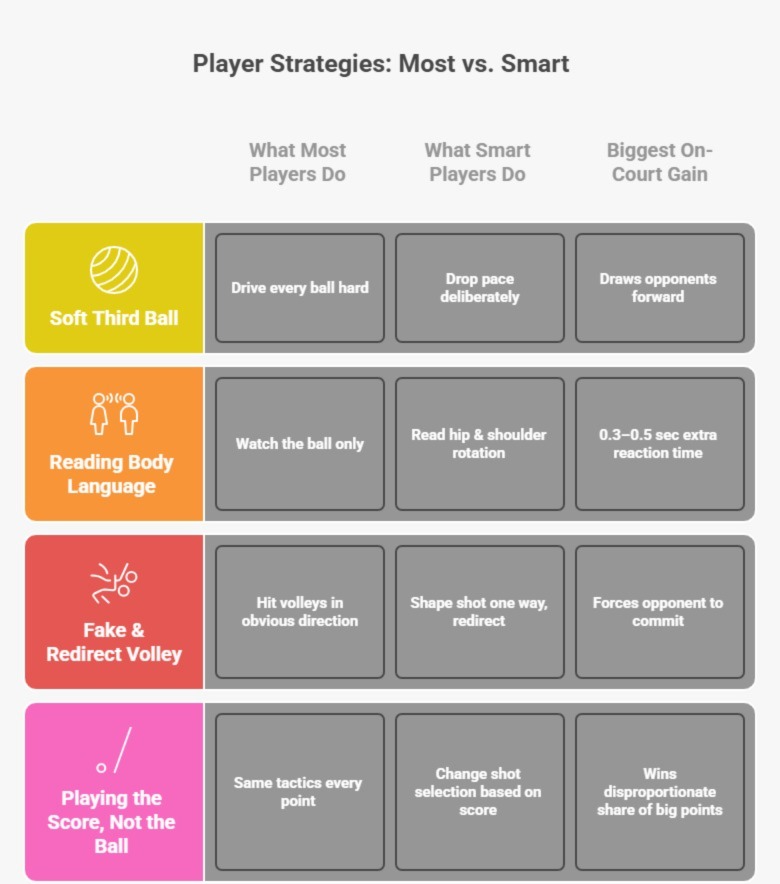
SECRET 1: The Soft Third Ball
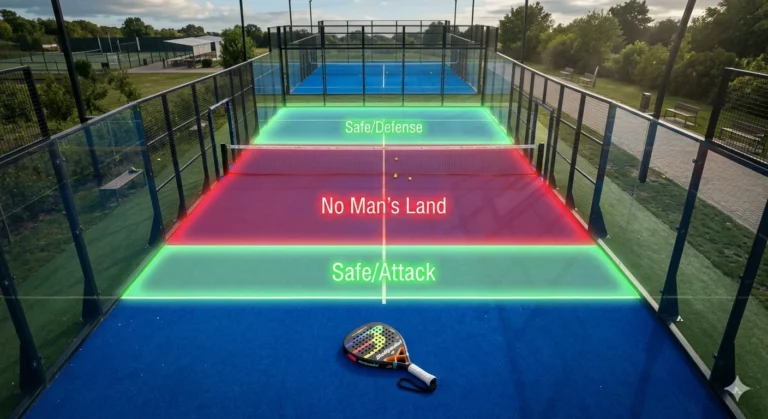
What it is: Deliberately dropping pace on the third shot in a rally to disrupt opponent rhythm and force them out of their net position.
Every beginner is taught to hit the ball hard from the baseline. Every intermediate player learns that pace creates pressure. What almost nobody teaches until players reach a high competitive level is that deliberately removing pace at the right moment is often more disruptive than hitting harder.
The soft third ball works on a simple psychological principle: your opponent has loaded their anticipation and positioning based on the pace and rhythm of the first two shots. When the third arrives slower, lower, and shorter than expected, their split step is already committed to a different reaction. The result is that they arrive at the ball too early, off balance, and with no time to reset.
Slower, lower shots require more finesse than power. Developing the ‘soft hands’ required for a perfect reset shot is much easier if your equipment is forgiving. Using a Basic Padel Racket with a larger sweet spot allows you to absorb the ball’s pace and drop it softly into the kitchen zone
When to Use It
- When opponents are both at the net: A soft, low ball toward their feet forces an upward return from a cramped position instead of giving them a pace-rich ball to redirect with power.
- After two hard exchanges:The pattern break is most effective when opponents have fully settled into a rhythm of pace. The contrast is the weapon.
- As a transition shot: The soft third ball is not a defensive shot it is an approach shot. Follow it immediately to the net. The soft ball draws opponents forward and out of position, creating the opening you step into.
🎯 Execution Tip: The soft third ball should clear the net by no more than 30–40 cm and land in the service box. Aim for the T-junction between the centre service line and the service line the hardest spot for two net players to cover simultaneously.
SECRET 2: Reading Opponent Body Language
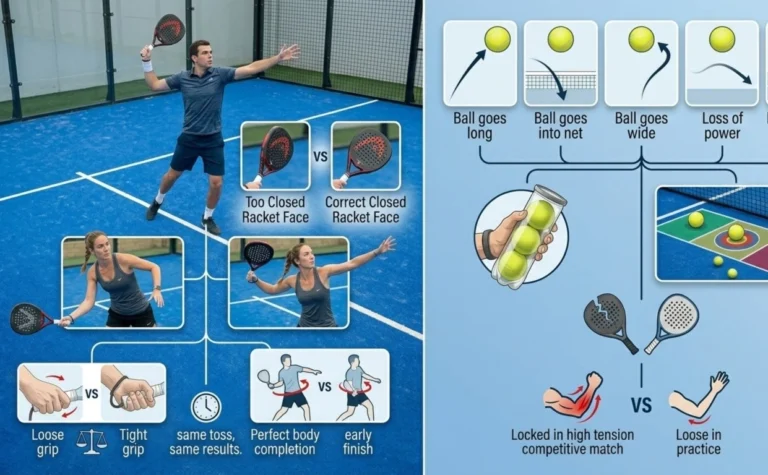
What it is: Using your opponent’s hip rotation, racket take-back, and shoulder angle to predict shot direction before contact giving you 0.3 to 0.5 seconds of extra reaction time per rally.
The single biggest difference between players who feel fast on court and players who feel slow is not their running speed it is how early they read what is coming. Elite padel players do not react to where the ball goes. They react to what the opponent’s body tells them before the ball is even struck. At club level, this skill is almost entirely untrained.
Reading body language in padel is a learnable perceptual skill, not an innate talent. The cues are consistent, reproducible, and available on every shot. Once you know what to look for, you will start anticipating shots that previously caught you completely off guard.
Gaining a split-second advantage by reading your opponent is only half the battle; you also need a racket that can react just as fast. An Intermediate Padel Racket offers a lighter frame that lets you snap your wrist into position the moment you anticipate their next move
The Body Language Reading Framework
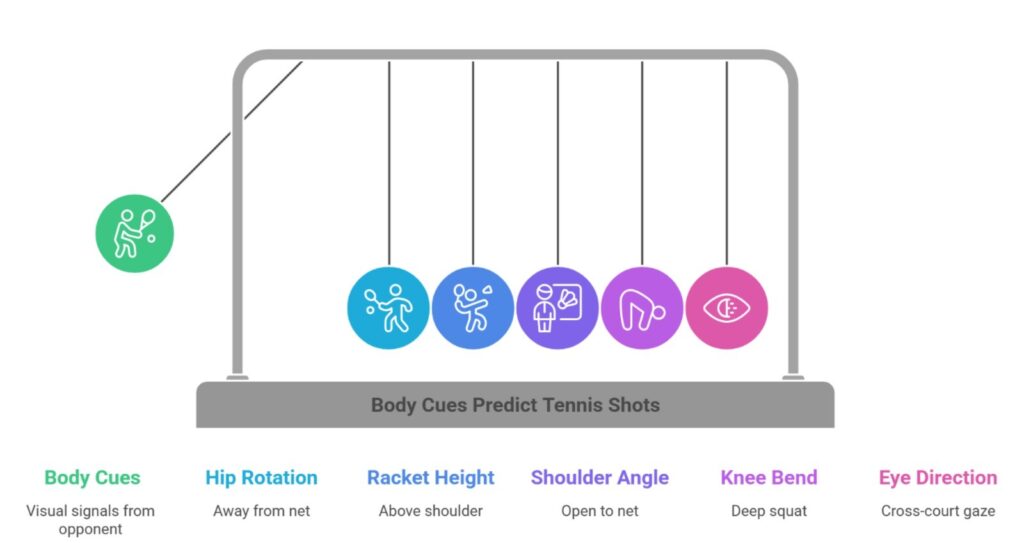
Training Method: During your next practice session, spend 10 minutes watching only your opponent’s hips not the ball. Call the shot direction out loud before it lands. This uncomfortable drill forces your visual system to build new anticipation pathways. Players who do this consistently for three weeks report significantly improved court coverage without changing their footwork at all.
SECRET 3: The Fake and Redirect Volley
What it is: Shaping your body and racket toward one direction during a volley, then changing contact angle at the last moment to redirect the ball the opposite way.
The most obvious volley is the least effective one. When you set up square to cross-court and hit cross-court, your opponent has already started moving in that direction the moment your body position telegraphed the shot. The fake and redirect volley breaks this predictability entirely and at club level, it works on almost every player the first time they encounter it because they have simply never trained to ignore visual deception.
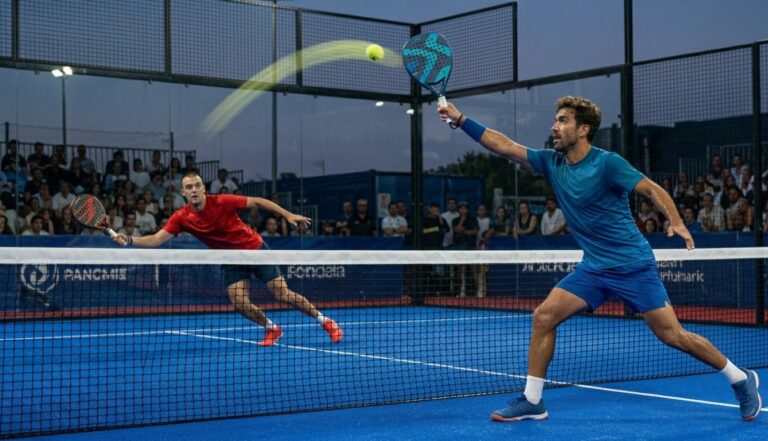
This technique is extensively used by net pairs on the Premier Padel circuit in 2025–2026. Pairs like Galan and Lebron use body feints and last-moment racket redirects to repeatedly wrong-foot baseline opponents, creating open-court volleys from situations where the opponent appeared to have full coverage. The mechanics are teachable and do not require elite athleticism only timing and commitment.
How to Execute the Fake and Redirect
- Set up your body language clearly toward the cross-court direction open stance, shoulders rotated, racket face angled cross-court.
- Wait until your opponent commits watch for their first step or weight shift. This happens 0.15 to 0.2 seconds before contact.
- At the last moment, close the racket face and redirect down the line or into the body. The change happens in the final 10 cm of your swing.
- Follow through normally an abrupt or hesitant follow-through signals the deception before contact and gives the opponent time to recover.
🎭 Deception Rule: The fake only works if you are genuinely committed to it. Half-hearted body language does not fool anyone. Set up the shot as if you are absolutely going cross-court then change at the last possible moment. Commitment to the fake is what creates the space the redirect exploits.
SECRET 4: Playing the Score, Not the Ball
What it is: Consciously adjusting your shot selection, risk tolerance, and tactical pattern based on the current score rather than playing the same way on every point regardless of context.
This is the secret that most club coaches barely mention and most club players never consciously apply. The score of a padel match is not just a number on a board it is a tactical instruction. The mathematically correct risk level for a given shot changes dramatically depending on whether you are 40-0 up or 0-40 down, whether it is game point or break point, whether it is the first game of the first set or the third game of the deciding set.
Professional players make these score-based adjustments automatically, without thinking. Club players almost universally do not. They hit the same aggressive cross-court drive at 40-0 and 0-40 even though the tactical logic for each situation is completely opposite. This mismatch between score context and shot selection is one of the most consistent and correctable sources of unnecessary errors at club level.
The Big-Point Principle
Research in sports psychology consistently identifies that the points at 30-30, deuce, and break point are disproportionately decisive players who win these specific points at a higher rate win more matches, even if they lose more points overall across a set. The reason: these moments create momentum swings that affect the next 3 to 5 points psychologically.
The practical application: identify the big points as they arrive, consciously commit to your highest-percentage shot, and execute it with full intention rather than hoping for a lucky winner. Big points are won by composure, not by inspiration.
 Match Habit: Before each point in a practice match, say the score out loud and ask yourself: ‘What is the smartest shot here given this score?’ It takes 3 seconds and will fundamentally change how deliberately you approach each point within four to six weeks of consistent practice.
How to Apply All 4 Secrets Without Overwhelming Your Game
The biggest risk with advanced tactical tips is trying to apply all of them at once and losing the natural flow of your game in the process. Here is the sequenced approach that produces the fastest improvement:
- Start with body language reading it requires no technique change, only a shift in visual focus. Begin in your next practice session.
- Add score awareness in your next match just say the score before each point. Awareness comes before adjustment.
- Introduce the soft third ball in friendly matches low-stakes contexts let you build feel for the shot without pressure.
- Practise the fake and redirect in drills specifically it requires isolated repetition before it becomes usable under match pace.
Final Word: The Best Players Are Students of the Game
None of these four secrets requires you to hit the ball harder, run faster, or develop a new physical skill. They require you to think more deliberately about rhythm disruption, about visual information, about deception, and about the tactical context that every score creates.
The padel players who keep improving past intermediate level are the ones who treat every match as a source of tactical data, not just a result. Start with one secret. Apply it intentionally for three weeks. Then add the next. Within two months, your opponents will start noticing something has changed even if they cannot quite name what it is.Tactical sophistication separates the best from the rest. Once you have mastered these secrets, ensure you have the equipment to match your new level. Explore our full range of Padel Rackets to find the specific tool your tactical game demands.”
The best padel players are not hiding secrets from you. They are simply paying attention to things most players have not been taught to notice yet.