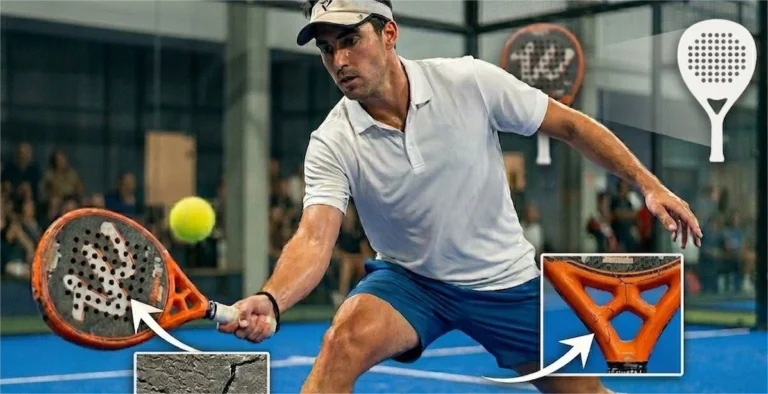
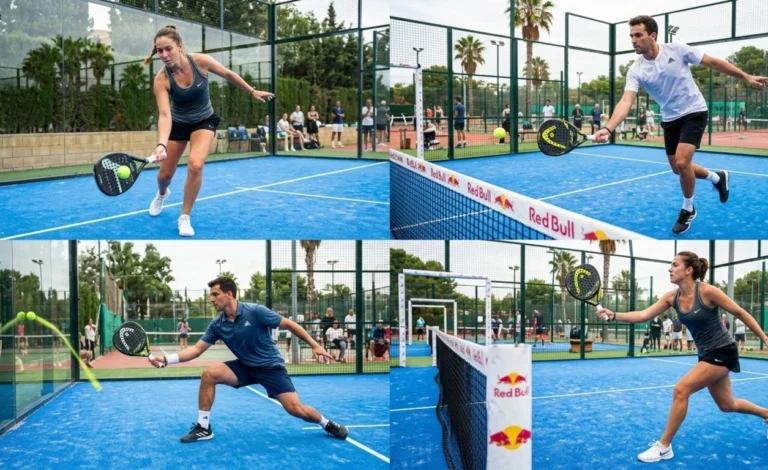
If your padel smashes are flying long, drifting wide, or dumping into the net more often than they should, the problem is almost never about power. It is about contact point, body mechanics, grip pressure, or equipment and each of these has a specific, correctable cause. The padel smash looks simple from the outside, but it is one of the most technically demanding shots in the game: a high ball, an overhead swing, and a target zone that punishes even small errors in timing or angle magnified by pace.
After analysing the overhead mechanics of club-level players across coaching sessions and match footage through 2025 and into 2026, six root causes account for the vast majority of smash errors. Fix even two or three of these and your overhead will become one of the most reliable weapons in your game rather than one of its biggest liabilities.
Most padel smash errors are not caused by lack of power. They are caused by a contact point that is 15 centimetres out of position, or a racket face that is 5 degrees too closed. Small mechanical issues, magnified by pace.
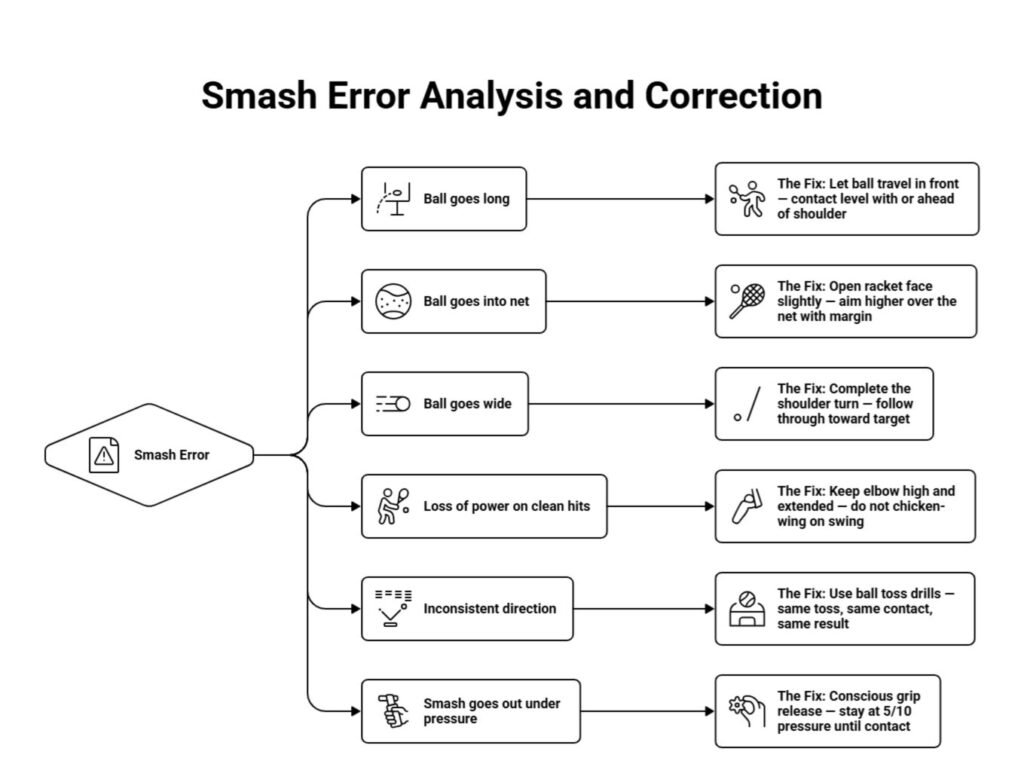
Smash Error Diagnosis — Quick Reference
REASON 1: Wrong Contact Point
The single most common cause of a padel smash going long is hitting the ball too far behind the shoulder. When the contact point drifts behind your hitting shoulder, your racket face naturally opens upward at the moment of impact sending the ball on a trajectory that clears the net by too much margin and lands beyond the baseline or into the back glass without bouncing aggressively downward.
The correct contact point for a padel smash is level with or marginally in front of your dominant shoulder, at arm’s extension above your head. This position naturally angles the racket face forward and downward, directing the ball into the opponent’s court with pace and a steep descent angle rather than a flat or rising trajectory.
How to Find the Right Contact Zone
- Shadow swing test: Stand without a ball and swing your smash motion slowly. Freeze at the contact point your racket should be directly above or fractionally in front of your shoulder, not behind your ear.
- Ball toss drill: Toss a ball directly above your shoulder and let it drop note where it lands relative to your feet. That ground position is your optimal contact zone. Recreate it on every smash.
- Side-on video:Film your smash from a side angle. If the ball is behind your shoulder at contact, the error is visible immediately and correctable within one practice session.
🎯 Contact Cue: Think ‘hit in front of the sun’ the ball should be in your full field of vision at contact, not disappearing behind your head. If you can see the ball clearly as you strike it, your contact point is right.
REASON 2: Closed Racket Face
When the smash goes into the net rather than long, the opposite problem is usually at work: the racket face is too closed at contact angled downward rather than forward. This typically happens when players try to ‘hit down’ on the ball aggressively, mistakenly believing that a steeper downward swing will produce a harder, more angled smash.
In padel, the smash does not need to be hit sharply downward to land in the court. The net is low, the court is short, and a racket face that is angled forward and slightly downward not fully vertical produces the correct trajectory. Overcorrecting toward a closed, downward face kills the shot into the tape.
- Racket face angle at contact: Aim for the face to be at approximately 10 to 15 degrees forward of vertical not fully vertical, and not angled sharply toward the floor.
- Net clearance target: Aim to clear the net by 30 to 50 cm on smashes. More margin than this and the ball lands long; less and it clips the tape. Practice hitting a deliberate target height above the net tape.
- Follow-through direction: Your racket should finish pointing toward the intended landing zone in the opponent’s court not downward toward the ground.
💡 Mental Image: Think of the smash as throwing a ball at the opponent’s service box you would not throw it straight down at the ground. You would throw it forward and slightly down. The racket follows the same physics.
REASON 3: Incomplete Body Rotation
A smash that curves out to the side missing wide rather than long or into the net is almost always caused by the hitter finishing their shoulder rotation too early. When the non-dominant shoulder stops pulling through before contact, the racket face is still angled across the body at the moment of impact, sending the ball sideways rather than forward.
The padel smash is a full-body rotational movement, not an arm swing. Power and direction both come from the kinetic chain feet, hips, torso, shoulder, arm working in sequence. Stopping that chain early at any point redirects the shot in an unintended direction.
- Shoulder turn completion: Your non-dominant shoulder should fully pull through at contact finishing so your chest faces the net, not the side glass.
- Hip lead: Your hips should begin rotating toward the net before your arm swings. If your arm is leading and your hips are static, you are arm-swinging rather than rotating and the smash will misdirect.
- Follow-through check:After the smash, your racket should finish across your body on the non-dominant side, low toward your hip. If it finishes high above your head, your rotation stopped mid-swing.
🔄 Rotation Drill: Practice slow-motion smash swings focusing only on completing the shoulder turn past contact. Do 20 repetitions before every session until the full rotation feels natural at match speed.
REASON 4: Elbow Drop
The ‘chicken wing’ error where the elbow drops toward the body before contact rather than staying high and extended is one of the most common mechanical faults in padel overhead technique. It affects both power and direction simultaneously: dropping the elbow shortens the swing arc, reduces racket head speed, and changes the angle of the face at contact.
The elbow should reach its highest point fully extended above the shoulder before the wrist snaps the racket forward at contact. Players who drop the elbow early are effectively shortening their lever at the worst possible moment, turning what should be a powerful smash into a weak, misdirected push.
- High elbow cue: At the top of your preparation, your elbow should be higher than your ear. If it is level with or below your ear, it is too low.
- Trophy position: The classic overhead ‘trophy position used in both tennis and padel has the elbow high, racket behind the head, non-dominant arm pointing at the ball. Reaching this position before swinging prevents the elbow drop.
- Wrist snap timing: The wrist snaps through at the very last moment after the elbow is fully extended. Players who snap the wrist early compensate by dropping the elbow. Sequence matters.
🏆 Pro Reference: Watch Alejandro Galan or Juan Lebron’s smash mechanics in slow motion on any 2025 Premier Padel match broadcast. The high elbow, full extension, and wrist snap sequence is textbook and replicable at club level with focused practice.
REASON 5: Grip Pressure Under Match Stress
Many players hit their smash cleanly in practice and erratically in matches. If this describes your experience, grip pressure is almost certainly the cause. Under competitive stress, most players unconsciously tighten their grip to 8 or 9 out of 10 locking the wrist, reducing swing arc, and sending the smash in unintended directions. The same mechanics that produce a good smash in practice are disrupted by tension before the racket even reaches the ball.
The continental grip recommended for padel smashes should stay at 4 to 5 out of 10 during the windup, tightening only to 7 at the moment of contact before releasing again. This squeeze-and-release gives the wrist freedom to snap through and keeps the face angle consistent regardless of match pressure. Players who have internalised this on a well-balanced padel racket with a comfortable grip size find the pressure management significantly easier than those fighting an oversized or undersized handle.
🧠 Pressure Habit: Before every smash in a match, consciously release your grip to 4 out of 10 during the windup. It takes 0.5 seconds and will measurably reduce your smash error rate under pressure within four weeks of deliberate practice.
REASON 6: Equipment Mismatch
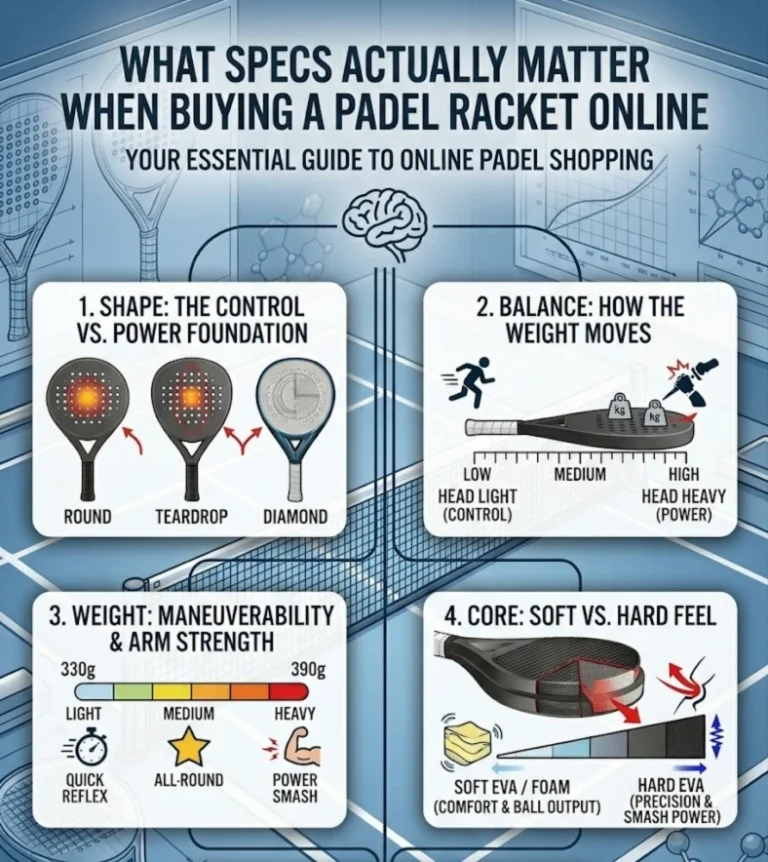
Not every smash problem is technique-based. If your mechanics are sound but your overhead errors persist, your racket may be contributing. Head-heavy diamond frames the most power-oriented option in the advanced padel rackets category demand consistent, precise contact at the top of the head to deliver on their promise. For players whose overhead contact is not yet that consistent, a diamond frame amplifies every slight contact error into a significant directional mistake.
Players at intermediate level who are experiencing persistent smash errors despite technique work often find significant improvement by switching to a mid-balance teardrop or hybrid frame, the standard recommendation across intermediate padel rackets where the larger sweet spot is more forgiving of the slight contact variations that occur under match pressure. Even experienced players returning from a break frequently benefit from a temporary step back to a control-oriented frame while rebuilding smash consistency.
- Head-heavy diamond frame:Unforgiving on off-centre smash contact. Correct only when technique is genuinely consistent.
- Mid-balance teardrop or hybrid:The most forgiving overhead frame. Builds smash consistency faster than a diamond for most club players.
- Grip size:An oversized grip locks the wrist and prevents the snap needed for clean smash direction. Check grip circumference most players do better at 105 to 115 mm.
- String tension:Dead strings reduce control on overhead contact. If your racket has not been restrung in over three months of regular play, the strings are contributing to your inconsistency.
Players new to padel experiencing early smash frustration will find the most appropriate overhead-friendly frames in the beginner padel racket range . Round frames with soft cores where the forgiving sweet spot builds confidence before technique is fully developed.
 Equipment Check: Do the tap test on your racket face — knock your knuckles across it in a grid. A consistent resonant tone means healthy strings and core. Dull flat zones mean the frame or strings need attention before your next smash session.
Final Word: Your Smash Is Fixable
Smash errors in padel are almost never random. They follow predictable mechanical patterns — the ball goes long when contact is too far back, wide when the rotation stops early, into the net when the face closes too much. Each pattern has a specific fix, and most of them can be corrected within two to four weeks of focused, deliberate practice.
Start with the contact point . It is the root cause of more smash errors than any other variable. Get that right first, then address rotation and face angle. Add grip pressure management for match conditions. And if your errors persist despite corrected mechanics, evaluate the equipment: the right racket for your current technique level removes the magnification of small errors that a mismatched frame creates.
A smash that consistently lands in the court at 70% power is worth more than a smash that goes out at 100%. Build consistency first. Power is easy to add once the mechanics are solid.
Most players can fix two or three of these within a few weeks of focused practice without changing anything else about their game. However, mastering the smash is just one part of becoming a dominant player. To truly separate yourself from the competition, you should also focus on the tactical side of the game. Explore our guide on 4 Secret Padel Tips & Tricks to discover the subtle shifts in strategy that most coaches skip.

 Equipment Check: Do the tap test on your racket face — knock your knuckles across it in a grid. A consistent resonant tone means healthy strings and core. Dull flat zones mean the frame or strings need attention before your next smash session.