Every padel player makes beginner padel mistakes that is not the problem. The problem is making the same ones for six months without knowing why your game is not improving. Most new players focus entirely on hitting the ball harder or learning flashy shots, while the real issues are much simpler: wrong grip, wrong position, wrong racket for their level, and no understanding of how the walls actually work. Fix those fundamentals and everything else the technique and the tactics, the consistency falls into place much faster than you expect.
This is not a list of vague advice. Every mistake below comes with a specific, practical fix you can take to your next session. Work through them one at a time and you will feel the difference within weeks.
The fastest padel improvers are not the ones who practise the most. They are the ones who stop repeating the same mistakes on every ball.
The 10 Mistakes
Every advanced padel player was once making at least eight of these ten mistakes. The difference between them and the players still making them is simply that they stopped deliberately, one mistake at a time.All 10 mistakes are listed below.
Gripping the Racket Too Tight
This is the single most common mistake in beginner padel and the one that causes the most physical damage. When you grip the racket tightly, you lock the wrist, kill the touch on soft shots, transfer all vibration directly into your forearm, and dramatically increase the risk of lateral epicondylitis commonly known as tennis elbow.
The correct grip pressure sits at about 5 out of 10 for baseline rallies firm enough to maintain control, relaxed enough for the wrist to move freely. On touch shots like the chiquita or the net volley, it drops to 3 or 4. Only on smashes does it tighten briefly to 7 or 8 and even then, only at the moment of contact.
The Fix
- Carry the racket loosely between points , let it hang naturally. This resets grip tension before every shot.
- During practice rallies, consciously think ‘soft hand’ before each stroke. The physical reminder breaks the white-knuckle habit.
- If your forearm aches after 30 minutes of play, grip tension is almost certainly the cause not weak muscles.
Injury Warning: Chronic tight-gripping is one of the leading causes of padel elbow in beginner players. It typically appears after 4 to 8 weeks of regular play and is almost entirely preventable with correct grip pressure from the start.
Playing With the Wrong Racket for Your Level
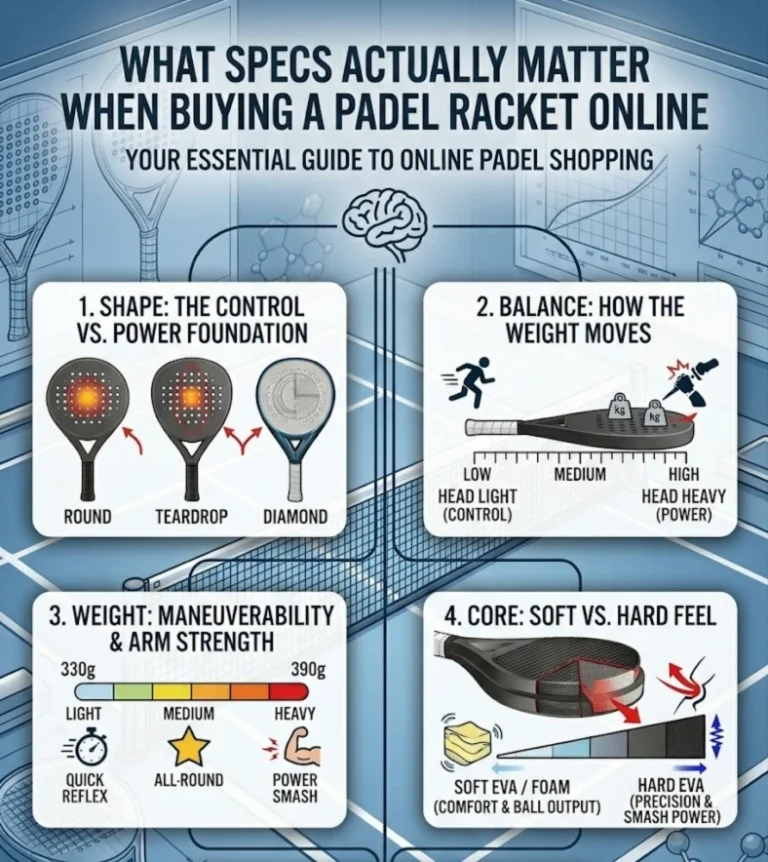
A stiff, head-heavy diamond frame in the hands of a beginner does not make them play like a pro. It makes them play like a beginner with a racket that punishes every off-centre hit harder than a forgiving frame would. This is one of the most expensive and most avoidable mistakes new players make often because they buy based on aesthetics or brand recognition rather than the actual specifications their level requires.
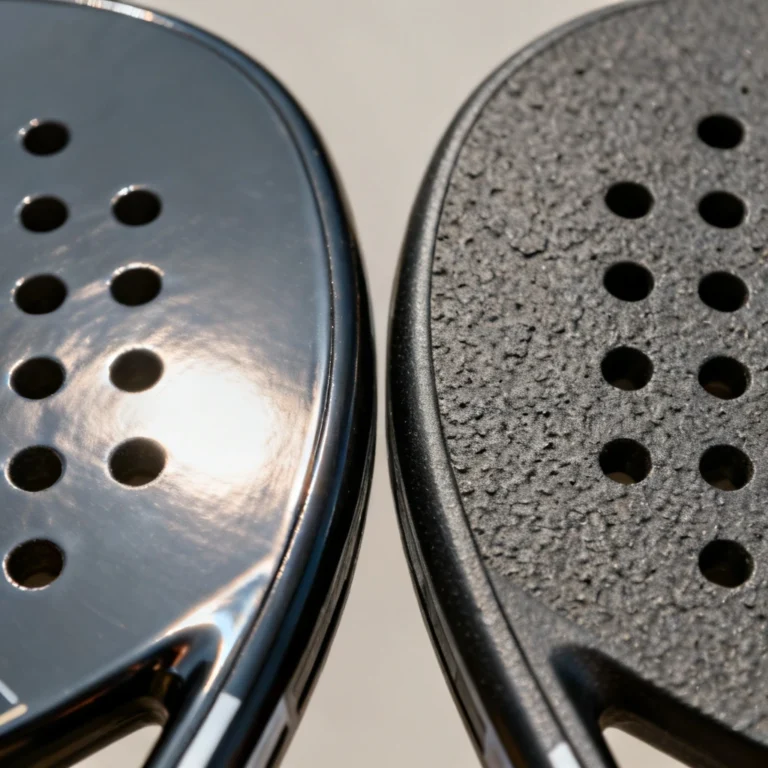
Beginners need a round frame with a soft EVA foam core, a large sweet spot, and a balanced or head-light weight distribution. These are not compromises, they are the features that actively help technique develop by giving clean, forgiving feedback and protecting the arm during the phase when swing mechanics are still inconsistent. The beginner padel racket is built specifically for this stage ,flexible fiberglass faces, soft cores, and balanced weight distribution that makes the learning curve genuinely easier.
The Fix
- If you have been playing for less than six months, you should be on a round or teardrop frame with a soft core — not a diamond.
- Check your racket’s balance point. Above 280mm from the handle base is head-heavy ,too much for most beginners.
- Once your technique is consistent and you are playing three or more times per week, the intermediate padel racket gives you the step up in feedback and precision your developing game will start to demand.
Quick Test: Hold your racket at arm’s length horizontally. If it tips forward noticeably, it is head-heavy. If it stays roughly level or tips back toward the handle, the balance is right for a beginner.
Ignoring the Walls
Padel is not tennis with walls. The walls are not obstacles , they are active parts of every point. Beginners who come from a tennis background almost always make this mistake: they try to hit winners before the ball reaches the back glass, they panic when the ball rebounds off the glass behind them, and they have no idea how to read where the rebound will land.
The back glass changes the game completely. A ball that passes you and hits the back wall comes back into play and a player who knows how to use that rebound can turn a defensive situation into an attacking one. Learning to read the wall angle is not advanced padel. It is the most fundamental skill separating a tennis player from a padel player.
The Fix
- In your first sessions, deliberately let balls pass you and practice the rebound shot from the back glass. Get comfortable with turning and striking off the glass before you worry about anything else.
- Stand closer to the back glass than feels natural about 1 metre away from it when defending. This gives you time to see the rebound angle and set your feet before striking.
- Remember the rule: if the ball hits the glass before bouncing, leave it. If it bounces first and then hits the glass, play the rebound.
Going for Power on Every Single Shot
This is the tennis transfer problem again. In tennis, pace wins points. In padel, placement and patience win points. Beginners who hit hard on every ball give their opponents predictable, high-bouncing shots that are easy to handle while exhausting themselves by the second game and generating a stream of unforced errors from shots that had no margin for error.
Padel is a game of construction, not destruction. You build pressure with consistent placement, smart positioning, and variation , then finish when the right opportunity arrives. A soft, accurate shot that lands in the right zone is worth ten times more than a hard shot that goes into the net or sits up for an easy smash.
The Fix
- Set yourself a rule for the first month: aim for 70% of your maximum pace on every baseline shot. Accuracy first, pace second.
- Count your unforced errors per game for two sessions. You will almost certainly find that most of them come from going for too much on shots that did not require it.
- Practise the soft cross-court rally keeping the ball low and consistent without pace. If you can maintain a 20-ball rally with a practice partner at 50% pace, your control is improving.
Tactical Note: In club padel, the player who makes fewer unforced errors wins the majority of matches not the one who hits the hardest. Consistency is a tactic, not a compromise.
Standing in No Man's Land
No man’s land in padel is the zone between the service line and the net approximately 2 to 4 metres from the net. It is the worst position on the court for almost every shot. You are too far from the net to volley effectively and too close to the back glass to handle a lob. Balls land at your feet. Every shot requires you to improvise.
Beginners end up here because they drift forward after hitting a good shot, or they fail to retreat after a defensive clear. The result is a half-position that leaves them vulnerable to both the lob over their head and the ball driven at their feet.
The Fix
- The two correct base positions in padel are: right at the net (1 to 1.5 metres from the tape) when attacking, and at the baseline (near the back glass) when defending. Commit fully to one or the other do not hover in between.
- After a defensive lob from the back court, actively retreat to the baseline. Do not drift forward in hope. Reset the position, then build the point again.
During practice, place a cone at the service line. Your rule: never stand near the cone during a rally. Force yourself to either advance past it or retreat behind it no lingering.
Not Watching the Ball All the Way to Contact
This mistake is so universal in beginners that coaches have a phrase for it: looking up early. The player sees the ball coming, decides where they want to hit it, and then looks at the target the opponent, the gap in the court before they have actually struck the ball. The result is consistently off-centre contact, loss of direction control, and mishits that feel inexplicable because the swing felt right.
Your eyes need to stay on the ball until after contact. Not during after. This sounds obvious but is physically difficult to maintain under match pressure, which is why it requires deliberate practice to build as a habit.
The Fix
- During warm-up rallies, say the word ‘contact’ out loud the moment your strings hit the ball. This forces conscious focus on the contact point rather than the intended target.
- Ask a practice partner to watch your eyes during a drill. If your head comes up before contact, they call it. You will be surprised how often it happens.
- Practise wall feeds alone drop the ball, let it bounce, and strike it against the wall while focusing entirely on watching the strings make contact. Ten minutes before a session builds the habit faster than any match drill.
Serving Flat and Hard
The padel serve is underarm and must bounce before crossing the net. It is not a weapon , it is a starting mechanism. Beginners who come from tennis try to serve with pace, often hitting the ball too high, sending it past the service box, or double faulting when the pressure of a second serve kicks in.
The serve in padel has one job: get the point started without giving your opponents a free point. A consistent, accurate serve to the backhand corner of the service box is far more valuable than a hard serve that goes in one time in three. The best beginner serve is a simple underarm slice that stays low, bounces into the correct box, and gives you time to advance into position.
The Fix
- Drop the pace completely on the serve for your first three months. Focus on accuracy hitting the correct service box not speed.
- Aim for the opponent’s backhand side every time until you have a consistent serve. Variation comes after consistency is established, not before.
- Practise 20 serves before every session as a standalone drill. Ten to each service box, focusing on the landing spot rather than the pace.
Playing Singles Tactics in a Doubles Game
Padel is a doubles sport.Every tactical decision where you stand, where you hit, when you move involves your partner. Beginners who come from individual racket sports instinctively play for themselves: they chase every ball, they leave their partner’s side uncovered, they hit for personal winners without thinking about the court structure they are creating or destroying.
In padel doubles, your position relative to your partner matters as much as your position relative to the ball. The pair moves as a unit , both advancing together, both retreating together, both shifting laterally in sync. A player who chases the ball individually breaks this unit and leaves the court exposed on every shot.
The Fix
- After every shot, glance at your partner before moving. Where are they? Where does the court need covering? Move to balance the pair, not to chase the ball.
- Agree on simple verbal cues before every match ‘mine’, ‘yours’, ‘back’, ‘up’. Two words of communication prevents the majority of confusion points.
- Watch your side of the court not the full court. Your job is your half. Trust your partner with theirs. Beginners who try to cover everything end up covering nothing.
Club Level Data: Research in club padel doubles shows that a majority of beginner errors occur not from technical mistakes but from positional confusion between partners. Communication and unit movement fix these errors faster than any technical drill.
Skipping the Warm-Up
Padel is a sport of explosive lateral movements, rapid direction changes, and rotational striking. The muscles and tendons involved shoulder rotator cuff, lateral elbow, hip flexors and need time to prepare for these demands. Beginners who walk straight onto court and start playing hard are risking injury in the first five minutes and performing below their actual level for the first full game.
A proper padel warm-up takes ten minutes maximum and has an immediate, measurable effect on your first-game performance. Players who warm up consistently make fewer technical errors early in the match, recover faster between points, and reduce their injury risk significantly over a full season of play.
The Fix
- Five minutes of light movement jogging, lateral shuffles, arm circles, hip rotations before touching a racket.
- Five minutes of gentle cooperative rallying from the baseline at 40% pace. No winners, no pace, just clean contact to warm up the swing mechanics.
Three to five serves each, starting slowly and building to match pace. The serve warm-up specifically prepares the shoulder and elbow for the rotation demands of match play.
Not Communicating With Your Partner
The most preventable source of lost points in beginner doubles is not a technical mistake , it is silence. Two players who do not communicate end up going for the same ball, leaving the middle uncovered, and making positioning decisions based on assumptions rather than information. Every time two players hesitate over who takes a ball in the middle, the point is already half lost.
Communication in padel does not mean a conversation during the point. It means two or three clear words before and after each exchange ,calling the ball, signalling position changes, confirming the serve target. Experienced pairs develop this into an almost automatic rhythm. Beginners need to build it deliberately.
The Fix
- Make a rule: every ball that could go to either player gets called ‘mine’ or ‘yours’ before contact. No silent balls in the middle.
- Between points, always say one thing to your partner. What you saw, what you want to do next, what the opponent is doing. One sentence is enough to maintain shared tactical awareness.
- After the match, spend two minutes with your partner reviewing what worked and what did not. Beginner pairs who debrief after sessions improve their coordination faster than those who just play.
The Right Racket Makes All of This Easier
Several of the mistakes above like tight grip causing elbow pain, inconsistent contact, lack of touch on soft shots are made worse by the wrong racket. A frame that is too stiff, too heavy, or too head-heavy amplifies every technical error and makes the correction process harder than it needs to be. If you are a new player still working through the mistakes in this list, starting with a purpose-built beginner padel racketremoves one significant variable from your development. The fiberglass face and soft EVA core give you the forgiveness and touch that make clean technique easier to build rather than fighting your equipment while you are still learning the game.
As your game develops and the mistakes on this list start to disappear, the natural next step is a frame with more feedback and precision. Intermediate padel racket range is designed exactly for that transition when your technique is consistent enough to feel the difference a stiffer face makes on placement and touch, but not yet at the level where a full pro padel racket is the right choice. The progression is logical, level-matched, and directly tied to where your game actually is not where you want it to be.