The control vs power padel racket question is the one every new and developing player hits within their first few months of the game. The choice matters more than most people realise not because one type is objectively better, but because choosing the wrong one for your current level creates a mismatch that quietly undermines your development for months. Get it right and the racket works with your game. Get it wrong and you spend every session fighting equipment that was designed for someone else.
The honest answer is not simply ‘control for beginners, power for advanced .It is more specific than that and in 2026, with padel equipment more sophisticated and varied than at any previous point in the sport’s history, understanding what separates these two racket types is genuinely useful for every player at every stage.
Buying a power racket before your technique is ready does not make you play with more power. It makes you play with less control and more errors.
What Actually Separates Control from Power Rackets
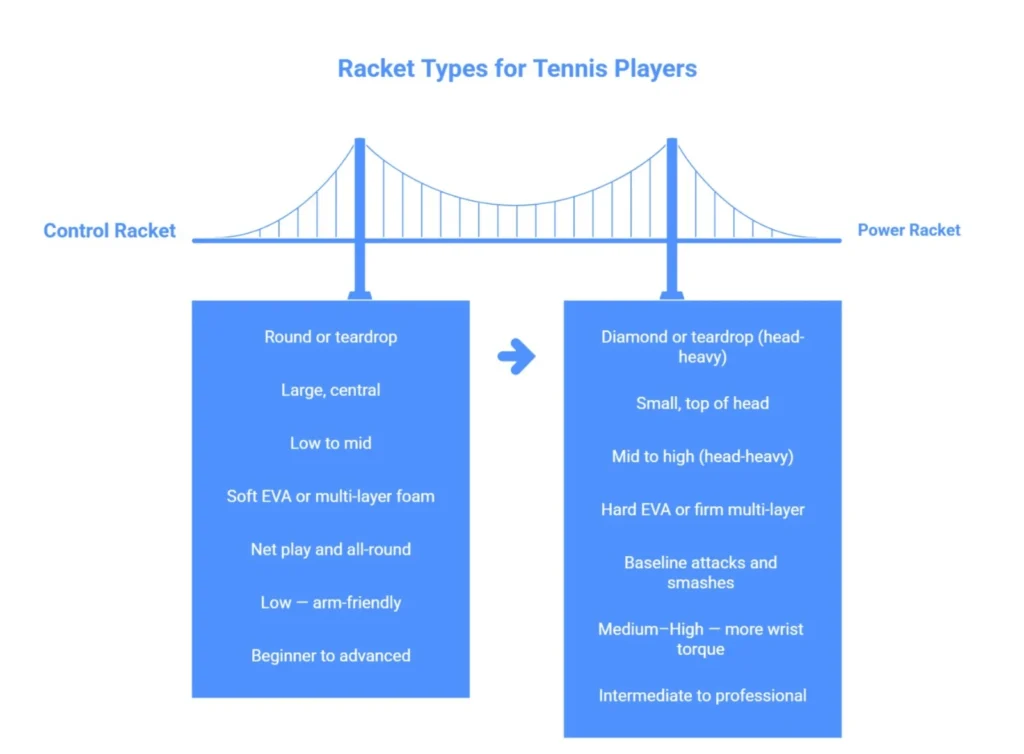
The difference between a control and a power padel racket is not just marketing copy it comes down to four concrete physical variables: shape, balance point, core material, and sweet spot position. Each of these affects how the racket behaves on contact and, consequently, what kind of player it suits.
Shape and Sweet Spot
Control rackets are predominantly round or teardrop-shaped, with the sweet spot sitting in the centre of the face. This is the zone where most players naturally make contact, which means off-centre hits still travel with reasonable direction and pace. A round-frame padel racket is specifically engineered to maximise this forgiving zone the geometry puts accuracy before everything else.
Power rackets are predominantly diamond-shaped, with the sweet spot positioned high in the head. This elevated sweet spot generates more ball speed when struck cleanly because the head weight amplifies the momentum of the swing. The trade-off is precision: the smaller sweet spot punishes any contact that is not close to perfect.
Balance Point and Core Material
Control rackets carry a low or mid balance point the weight sits toward the handle, making the racket feel light, quick to manoeuvre, and easy on the wrist and elbow. Power rackets carry a mid-to-high balance, shifting mass toward the head to generate more kinetic energy through the hitting zone. The core material follows the same logic: soft EVA or multi-layer foam in control frames for vibration dampening and dwell time; firm or hard EVA in power frames for maximum rebound pop.
⚖️ The Core Rule: Soft core + low balance = control and comfort. Hard core + high balance = power and demand. Every other spec on a padel racket flows from this pairing. If you are unsure which camp a specific frame belongs to, check these two variables first.
The Case for Buying a Control Racket First
The argument for starting with a control racket is not sentimental it is mechanical. Padel is a sport where most points are decided by consistency, not by outright power. The pair who makes fewer unforced errors across three sets wins more often than the pair who hits harder but with less reliability. A control racket is built around that reality. It is why the majority of beginner padel rackets on the market are round or teardrop frames with soft cores not because beginners do not want power, but because consistency is what wins games at every level below elite professional.
The developmental argument is equally strong. Technique built on a control racket transfers to a power racket when the time is right. Technique built on a power racket with its smaller sweet spot and head-heavy balance often develops compensatory habits: players swing harder to hit the top of the head consistently, develop wrist tension from managing the heavier head, and build muscle memory around an imprecise contact zone. These habits are significantly harder to unlearn than they are to avoid.
- Larger sweet spot means faster learning: More of your shots go where you intend, which gives your brain faster and more accurate feedback on what your technique is actually doing.
- Low balance protects developing technique: You build swing mechanics around comfort and control not around compensating for a heavy head.
- Control first means power is always addable: Moving from a control frame to a power frame as your technique matures is a natural, one-step progression. Going the other direction is not.
🎓 Development Insight: After testing multiple development pathways across club-level players in 2025, padel coaching data consistently shows that players who started on control frames reached competitive intermediate level faster than those who started on power frames because their contact mechanics were cleaner from the beginning.
When a Power Racket Is the Right Choice
Power rackets are not for beginners who want to hit harder. They are for players whose technique has reached a level of consistency where the smaller sweet spot no longer punishes them and the head-heavy balance generates meaningful additional output on smashes and drives. If you are hitting the sweet spot on 75–80% of your shots with your current control frame and finding it limiting on overhead smashes, a transition to a power-oriented intermediate padel racket specifically a mid-to-high balance teardrop rather than a full diamond is a technically justified upgrade.
Full diamond power frames the most head-heavy, smallest sweet spot option in the market are genuinely best reserved for physically strong, technically consistent players at advanced competitive level. In the hands of a player who is not ready for them, a diamond frame is one of the fastest ways to plateau it amplifies errors as readily as it amplifies clean strikes.
- The right moment for a power upgrade: When your current control frame feels like it is holding back your smash output rather than supporting your consistency.
- The wrong reason for a power upgrade: Because the frame looks impressive or because a more advanced player uses one. Equipment does not substitute for technique readiness.
- The smart middle ground: A mid-balance teardrop at intermediate level it adds power over a round frame without committing to the full demand profile of a diamond.
🏆 Pro Context: Most players on the Premier Padel circuit in 2025–2026 use teardrop or diamond frames but they have the technique to consistently hit the elevated sweet spot under match pressure. That technique took years to develop. The frame followed the skill, not the other way around.