Cold muscles are not just uncomfortable they are mechanically compromised. Muscle tissue at rest temperature is less elastic, less powerful, and less capable of absorbing the sudden shock loads that padel demands. Tendons and ligaments are similarly stiff, which means the lateral lunge you execute comfortably in the third game of a warmed-up session is the same movement that tears a hamstring in the first game of a cold one.
The Three Physiological Risks
- Reduced muscle elasticity:Cold muscle fibres are shorter and less flexible. A sudden explosive movement a wide defensive lunge, a split step, a hard smash exceeds the elastic range of unprepared muscle tissue and produces a strain or tear.
- Impaired neuromuscular signalling:Reaction speed, coordination, and the split step timing that is critical for net play all depend on fast nerve-to-muscle signalling. Cold tissue slows this signalling measurably, which is why the first game without a warm up always feels sluggish and mistimed.
- Joint vulnerability:Synovial fluid the lubricant inside your joints needs movement and warmth to distribute properly. Cold joints, particularly the shoulder and knee, experience significantly higher friction and impact stress on the first overhead or hard directional change.
 Injury Context: Padel elbow lateral epicondylitis is one of the most common overuse injuries in the sport. Playing through poor shoulder and wrist warm up on cold tissue accelerates both the onset and severity of this condition. The rotational load of the padel smash on an unprepared rotator cuff is a primary contributor to shoulder injuries that sideline club players for weeks to months.
Beyond injury prevention, the padel warm up has a direct and measurable effect on shot quality, reaction speed, and tactical decision-making in the opening games of a match. These are not marginal improvements they are the difference between a clean, confident start and a first set that feels like you are playing through fog.
Players who complete a proper pre-match warm up including a rally phase that builds through groundstrokes to volleys and overheads arrive at the first point with calibrated eye-to-hand timing, a warmed contact point feel, and a tested grip pressure. Those who step straight onto the court spend the first 10 to 15 minutes recalibrating all of these things mid-match, which costs games. This is particularly true for players upgrading from a beginner padel racket to a more demanding frame. The new balance and swing weight require a brief warm up to recalibrate muscle memory before competitive play.
- Reaction speed:Neuromuscular system response time improves by 15 to 20% after a 10-minute dynamic warm up compared to a cold start.
- Contact timing:Eye tracking and hand-eye coordination reach peak performance approximately 8 to 12 minutes into physical activity not at the first shot.
- Shot confidence:Players who have hit 20 rally balls before the first point start with established rhythm and consistent contact feel. Cold starters spend the first game finding that rhythm.
- Mental readiness:The warm up is also a cognitive transition from daily life to match focus. Players who warm up properly make better early tactical decisions because their attention has been redirected to the court, not the office.
 Performance Note: A 2024 study from the International Journal of Racket Sports Science found that players who completed a 15-minute sport-specific warm up won 23% more points in the opening game of a match compared to those who warmed up for under 5 minutes. In a competitive club match, first game momentum matters enormously
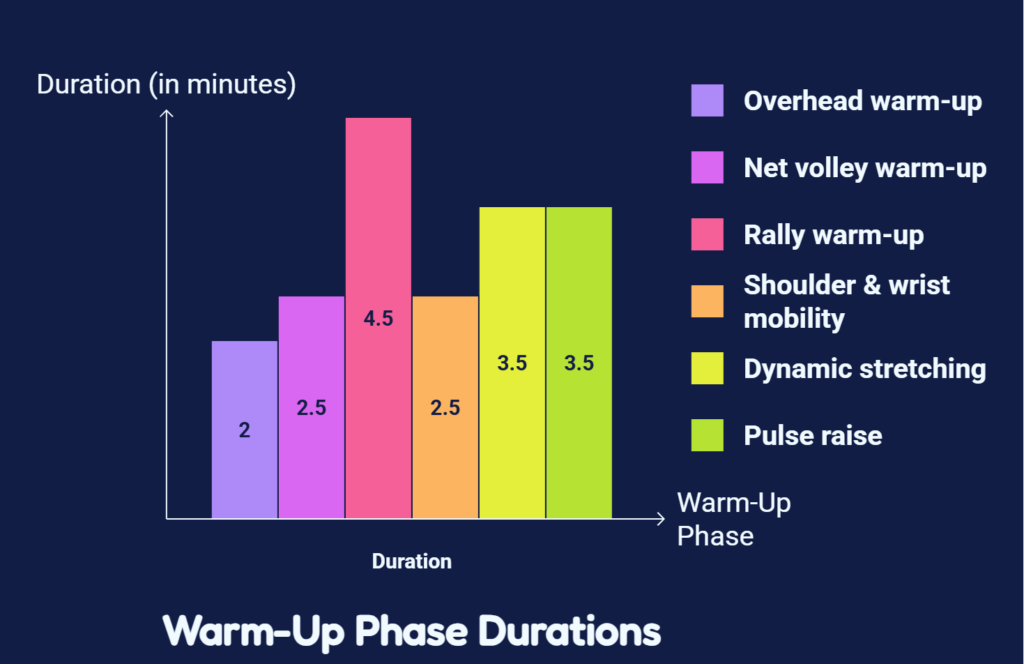
Padel players warm up their legs far more consciously than they warm up their shoulder and wrist yet the shoulder bears the highest acute injury risk in the sport. Every overhead smash, every bandeja, every vibora loads the rotator cuff, the bicep tendon, and the shoulder capsule through a full overhead arc. Doing this on cold, unlubricated tissue is precisely how players develop the chronic shoulder injuries that define the second half of many club padel careers. Furthermore, cold shoulder tissue drastically alters your swing mechanics, forcing errors that can cause your overheads to sail long or dump into the net. If you are already struggling with your overhead consistency, check out our diagnostic guide on why do padel smashes go out to fix your contact point alongside your physical preparation.
The shoulder warm up does not need to be complicated. Arm circles (small to large, forward and back), cross-body shoulder stretches, and five to ten easy overhead shadow swings with your padel racket at reduced pace are sufficient to prepare the rotator cuff for full overhead load. Advanced players using a intermediate padel racket or advanced padel racket both of which carry more head weight than a beginner frame ,he should spend an additional two minutes on shoulder mobility, as the heavier head amplifies rotator cuff load on every overhead swing.
Wrist Warm Up — Three Minutes That Protect Your Season
The wrist absorbs repeated vibration and torque load throughout every padel session. Wrist flexion and extension circles, gentle resistance band wrist curls, and five to ten slow volleys at the net before competitive hitting prepare the wrist flexors for the rapid grip changes and contact redirections that net play demands. Players who manage chronic padel elbow or who want to avoid it entirely should treat wrist warm up as non-negotiable, not optional.
- Wrist circles:10 rotations in each direction of both wrists.
- Wrist flexion and extension:10 slow repetitions each against light resistance or bodyweight.
- Grip squeeze and release:10 slow squeezes to wake up the forearm flexors before the first full-speed volley.
 Equipment Note: If you regularly experience wrist or elbow discomfort in the first 10 minutes of play despite warming up, your racket may be contributing. A head-heavy frame transmits more vibration to the forearm on cold tissue than a mid-balance alternative. Players managing this issue often find significant relief switching to a softer core frame from the beginner or intermediate range while the tissue adapts.