Most players who have been playing padel for a year or more feel comfortable with the basics — the serve, the walls, the scoring, the out boundaries. But there is a set of padel rules you almost certainly did not know about when you started, and that a surprising number of experienced club players still get wrong today. These are not obscure technicalities buried in a 200-page rulebook. They are live, match-relevant situations that come up regularly and every time one of them does, the player who knows the rule wins the point without argument. The player who does not know it either concedes it unnecessarily or plays it incorrectly and loses it anyway.
These four rules are all official. They are all in the FIP rulebook. And once you know them, you will start noticing the situations they apply to in almost every session you play.
The difference between a player who knows the rules and one who does not is not just legal accuracy .It is free points. Multiple times per match, at every level.
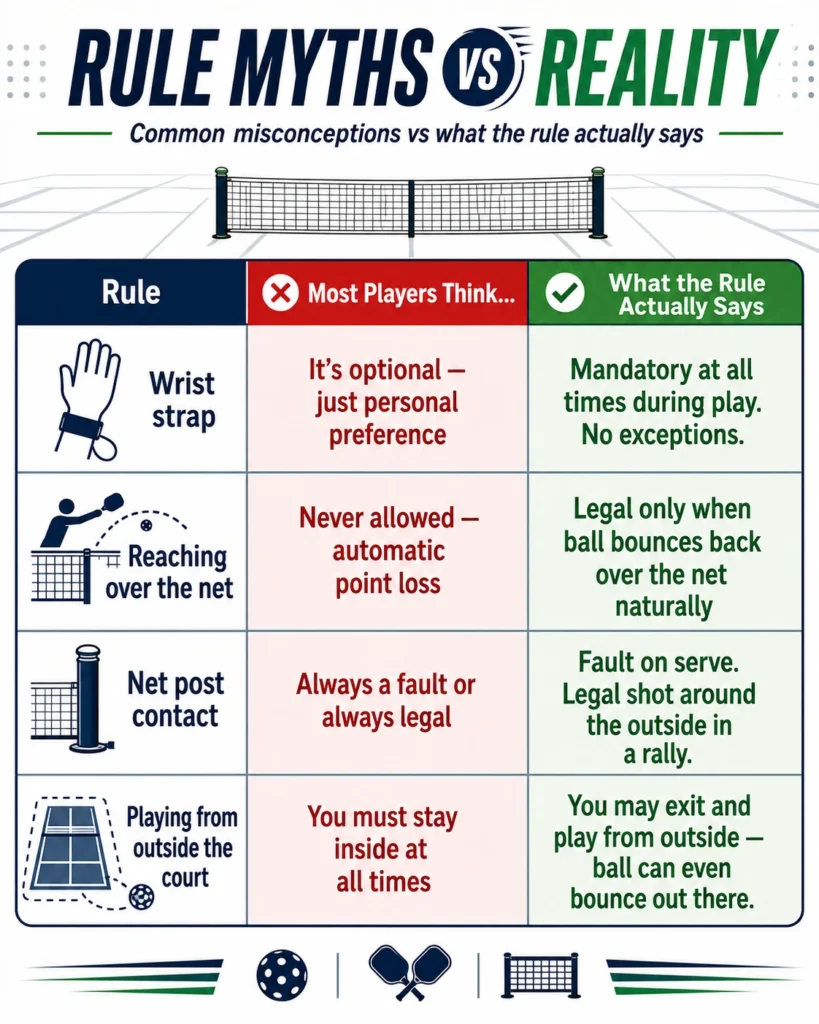
The 4 Rules at a Glance
The Wrist Strap Is Not Optional
This is the most consistently broken rule in recreational padel and the one that almost nobody knows is actually a rule at all. Most players treat the wrist strap as a precaution, the same way you might choose to wear a wristband. Something useful, something recommended, but ultimately optional.
It is not optional. Under official FIP padel rules, the wrist strap must be worn at all times during play. Not just during serving. Not just at the net. At all times, throughout the entire match. A racket without a wrist strap in use is technically a rules violation from the moment the first point begins.
Why This Rule Exists
Padel rackets are solid, heavy frames significantly denser than tennis rackets with no string tension to absorb impact. During fast exchanges at the net, the racket can torque sharply on contact and slip from the grip, particularly on mis-hits. Without the wrist strap, a slipping racket becomes a projectile in a confined, glass-walled court surrounded by other players. The rule exists because the safety risk is real and specific to the enclosed nature of padel courts.
What This Means in Your Next Match
- Check before you serve. If your wrist strap is not through your wrist, it is not being worn , it does not count just because it is on the racket handle.
- At a competitive or tournament level, an opponent or referee can call this violation. In social club play, almost nobody does but the rule exists regardless.
- If you coach players or run sessions, this is worth raising explicitly. Most beginners have never been told it is mandatory and simply mimic what they see other players doing.
 Safety Note: In the UK, several padel injury reports involving racket-drop incidents in enclosed courts have cited wrist strap non-use as a contributing factor. This is not a bureaucratic rule .It has a direct physical basis in the specific conditions of padel play.
You Can Reach Over the Net
Every padel player has been in this situation or watched it happen: the ball is played, it clips the top of the net, and instead of continuing into the opponent’s court it loses momentum and spins back toward the side that played it. Both pairs freeze. Nobody is sure what the rule is. The point usually gets replayed or conceded, almost always incorrectly.
Here is the official rule: you are allowed to reach your racket over the net and play the ball but only under one specific condition. The ball must first bounce on your side of the net and then travel back over the net either from spin, wind effect, or net contact without your opponents touching it. At the moment the ball crosses back over the net of its own movement, you have the legal right to reach over and play it before it bounces again.
The Exact Conditions Required
- The ball must have bounced on your side first. If it has not bounced , if it is still in flight , you cannot reach over the net under any circumstances.
- The ball must cross back over the net without your opponents touching it. If an opponent touches it before it crosses back, the point is decided by that touch, not by the net crossing.
- You must not touch the net yourself. Reaching your racket over is legal. Your body, clothing, or racket frame making contact with the net simultaneously is an immediate point loss.
The Mistake Players Make
The most common error is hesitating.Seeing the ball spin back and watching it bounce a second time on your side before anyone plays it. At that point the point is over: two bounces on your side means you lost it. The window to reach over is the moment the ball crosses the net on its way back. Knowing the rule removes the hesitation. The player who moves first and plays the shot wins the point cleanly.
The Net Post Rule
The net post is one of the most misunderstood structural elements of a padel court. Most players assume it functions the same way throughout the entire match that any contact with it is either always a fault or always legal. Neither is correct. The rule depends entirely on whether the ball is being served or whether a live rally is in progress.
On a Serve: Net Post Contact Is Always a Fault
During the serve including the delivery itself and the bounce if the ball makes contact with the net post at any point, the serve is a fault. This is the same rule as tennis. Clean and absolute. A first serve hitting the post counts as a first-serve fault. A second serve hitting the post is a double fault and the point goes to the receiving pair. There is no exception and no replay.
During a Live Rally: Around the Post Is a Legal Shot
This is the rule that genuinely surprises most players. During a live rally — after the serve — you are permitted to play the ball around the outside of the net post, as long as it lands legally in the opponent’s court. The ball does not have to cross over the net tape. It can travel around the side of the post and still be a valid shot if it lands within the correct boundaries.
This only applies on courts where there is physical space between the net post and the side glass which is most standard padel courts. On courts where the net runs directly to the glass with no gap, the shot is not physically possible and therefore irrelevant.
Why Players Get This Wrong
- Players assume the post is always an obstacle — they stop when the ball hits or passes the post during a rally.
- Players have never seen the around-the-post shot attempted and assume it must be illegal purely because it looks unconventional.
- The serve rule and the rally rule are different, and most players have only ever heard one version.
📋 Official Reference: Both the net post serve fault rule and the around-the-post rally rule are documented in the International Padel Federation rulebook. The FIP official padel rules (padelfip.com) cover both situations explicitly under the sections on serves and live ball play. Worth bookmarking for any serious club player or coach.
You Can Exit the Court and Play from Outside
This is the rule that generates the most disbelief when players hear it for the first time and produces the most spectacular points when they see it executed correctly. In padel, you are allowed to exit the court through the side or back gates and play the ball from outside the court boundary. The ball can even bounce outside the court and still be legally returned.
The mechanism is this: if a ball exits through an open gate or over the glass without bouncing twice on the court, it is still in play. A player can chase it outside the court boundary, let it bounce once outside, and return it back into the opponent’s court. The return must land within the boundaries of the opponent’s side but the player making the shot can be standing completely outside the court when they hit it.
When This Actually Happens
This is most commonly seen after a powerful smash or a mis-hit that sends the ball through an open gate at the side. In competitive club play and in professional matches, players chase these balls with the intention of playing them back and on courts with space around the perimeter, this produces some of the most visually extraordinary points in the sport.
- The ball must not have bounced twice before the player reaches it . Two bounces ends the point, regardless of where the second bounce happens.
- The gate must be physically open .A ball that hits a closed gate and rebounds back into the court is still in play on your side and can be continued normally.
- The return must land in the correct zone of the opponent’s court .The fact that the player is outside the court does not change the landing zone requirements for the ball.
🎾 Spectator Moment: The outside-the-court return is one of the reasons professional padel is one of the most entertaining racket sports to watch. Premier Padel broadcasts regularly feature players sprinting through gates and returning balls from five metres outside the court. At club level it is rarer but understanding that it is legal completely changes how you respond when you see the ball heading for the exit.
Rules Knowledge Is Part of What You Deliver
If you run a padel club, coaching programme, or academy, the four rules above are worth building explicitly into your beginner and intermediate induction sessions. Most new players receive a brief overview of the serve and the walls and very little else. They discover the wrist strap rule, the net post rule, and the outside-the-court rule through match disputes which is a far less productive way to learn them than a five-minute briefing before their first competitive session.
Clubs that take rules education seriously report fewer disputed points during social events, cleaner competitive sessions, and a noticeably better player experience from the first month of membership. It is a small investment with a measurable return in player satisfaction and retention.
There is one more element of club professionalism that directly ties into how players experience your programme: the equipment your players are seen using on court. Clubs and academies that run branded rackets , their own logo on the frame . Create an immediate visual identity that players associate with quality and belonging. Camewin’s customised padel rackets for clubs and academies let you put your club branding directly onto premium frames across beginner, intermediate, and pro tiers — with no need to design from scratch. You select the frame that matches your players’ levels, provide your logo, and Camewin handles the production. It is the fastest way to give your club a court presence that looks professional from day one.
Club Branding Note: Branded club rackets serve a dual purpose that most club managers underestimate. They create a visual identity on court that new members associate with the club and they function as walking advertising every time a member plays at another venue or takes their racket off court. Custom branding on equipment is one of the highest-visibility, lowest-cost marketing investments a padel club can make.
Know the Rules Before the Match
Rules disputes during padel matches are almost always caused by one thing: both pairs having different assumptions about what the official rule is. Neither is cheating. Both are working from an incomplete understanding of a rulebook most players have never read. The four rules in this guide and the three bonus situations above cover the majority of disputed points that occur at club level across the UK.
Read the full official rules once. The FIP padel rulebook is available online and is shorter and more readable than most players expect. You do not need to memorise every clause. Understanding the logic behind how the rules are structured what constitutes a fault, when the ball is in play, what the net rules are during a serve versus a rally gives you a framework that resolves almost any match situation correctly without needing to look anything up.
The players who know the rules play differently. They do not hesitate when the ball spins back over the net. They sprint through the gate instead of watching the ball bounce twice outside. They hold their position at the net knowing the reach-over is legal when the time comes. Knowing the rules is not just accurate .It is a competitive edge that costs nothing and never expires.
Every rule in padel exists for a reason. Understanding the reason makes the rule memorable and the memorable rule wins you the point when it matters.

 Safety Note: In the UK, several padel injury reports involving racket-drop incidents in enclosed courts have cited wrist strap non-use as a contributing factor. This is not a bureaucratic rule .It has a direct physical basis in the specific conditions of padel play.